The State of South African Digital Marketplaces in 2026
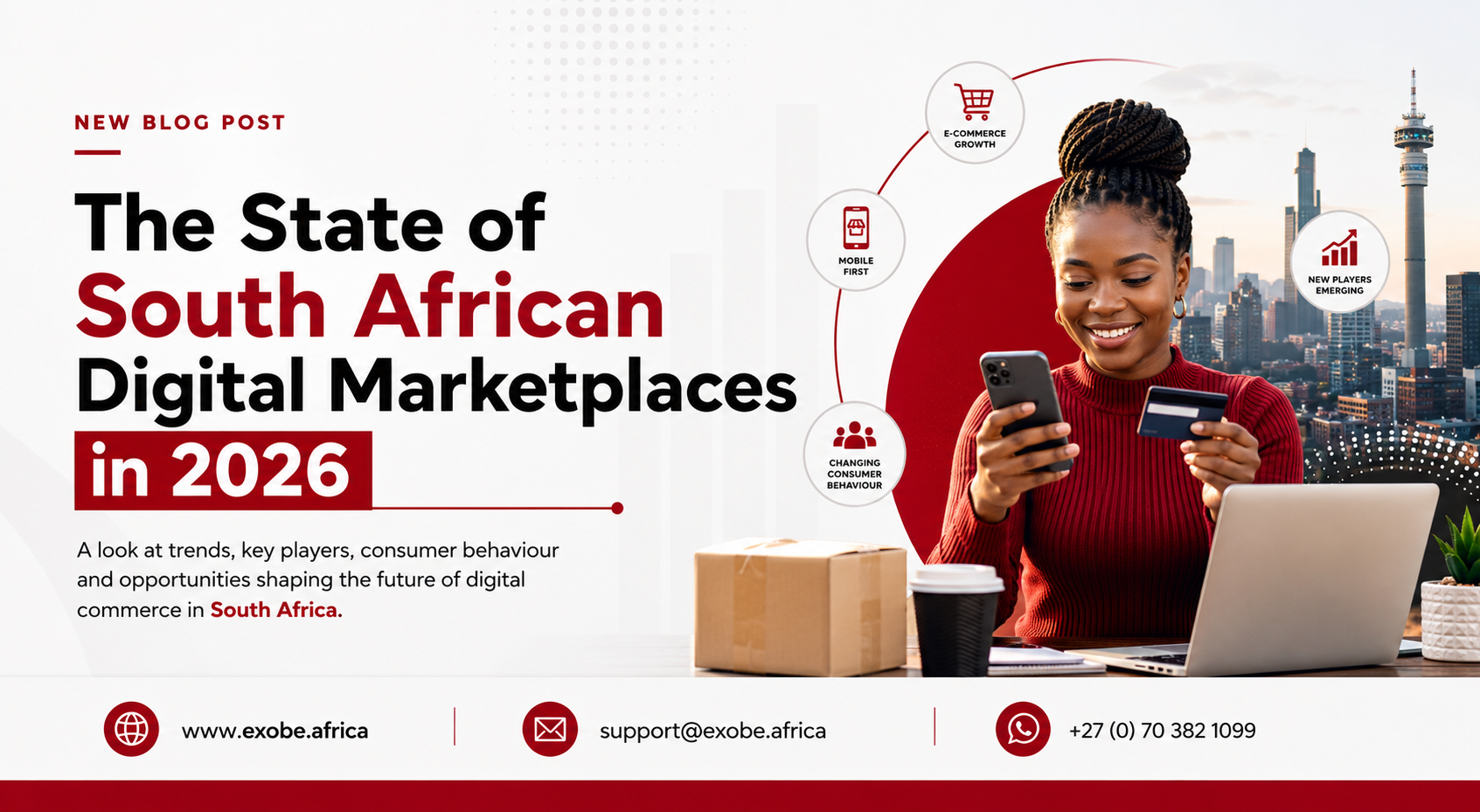
South Africa is not behind the digital curve. It is on its own curve - one shaped by its own infrastructure, its own economic realities, and its own entrepreneurial energy. In 2026, that curve is accelerating. And the businesses that understand it will be the ones that benefit from it. This article is a clear-eyed look at where South Africa’s digital marketplace landscape actually stands: what the data shows, what it doesn’t show, and what it means for the small and medium-sized businesses trying to build something real within it.
What the Data Actually Says
South Africa’s digital retail market is now valued at over R225 billion annually, with year-on-year growth continuing at double-digit rates despite broader macroeconomic headwinds (Statista, 2025). That growth is being driven not primarily by large retail chains moving online, but by a shift in buyer behaviour, a fundamental change in how South Africans search for, evaluate, and purchase goods and services. Mobile is central to this story. According to World Wide Worx’s 2025 South African eCommerce Report, 68% of all digital transactions in South Africa now originate from a mobile device. For the majority of South African consumers, a smartphone is not just a way to shop online, it is the primary or only connected device they own. This has profound implications for how sellers must present their products, communicate with buyers, and manage their digital storefronts.
Internet penetration has reached approximately 72% of South Africa’s adult population (DataReportal, 2025), a figure that will continue to climb as data costs decrease and network coverage expands. The buyers are here. They are active. And the volume of what they are looking for online is growing every quarter.
“The buyers are here. They are active. The question is whether your business is visible to them.”
The MSME Gap: Why So Many Businesses Are Missing It
Here is the tension at the heart of this story. South Africa has over 2.5 million registered small and medium enterprises (Department of Trade, Industry and Competition, 2024). These businesses collectively employ more than 60% of South Africa’s formal workforce and contribute meaningfully to GDP. And yet, a significant proportion of them have no meaningful digital presence whatsoever.
Estimates from the International Trade Centre suggest that across Sub-Saharan Africa, fewer than 30% of SMEs have any form of digital storefront, a website, a marketplace listing, or a functional e-commerce capability (ITC, 2024). The figure is not dramatically better in South Africa, despite the country’s relatively advanced digital infrastructure compared to its regional peers. Why? The barriers are well-documented. Building and maintaining an independent e-commerce website requires capital, technical skill, and ongoing maintenance - none of which most MSMEs can easily absorb.
Social media selling, while popular, lacks structured product cataloguing, payment processing, and the discoverability that search-driven commerce provides. The tools that exist have largely been built for developed-market businesses with reliable logistics partners, high card payment penetration, and predictable data costs. South African MSMEs need something different. The digital marketplace model, a shared platform that handles infrastructure, provides discoverability, and enables a seller to focus on what they do rather than on running a website - is the architecture that fits this market.
What Is Growing Fastest and Why
Category-level data from the 2025 World Wide Worx report points to consistent growth in food and groceries, health and beauty, home goods, and fashion as the leading online retail categories in South Africa by transaction volume. These are exactly the categories where South Africa’s informal and semi-formal MSME economy is strongest.
Equally significant is the emergence of service-based businesses on digital platforms. Electricians, caterers, event coordinators, domestic services, and personal care professionals are increasingly using digital platforms not to transact, but to establish credibility, enable discovery, and receive enquiries. The line between a product marketplace and a service directory is blurring and platforms that accommodate both will capture more of the market. PwC’s 2024 Total Retail Survey (South Africa) found that 78% of South African consumers research products online before purchasing, whether the final transaction happens digitally or in person. This figure alone reframes the entire argument for being online. It is no longer a question of whether your buyers transact digitally. It is a question of whether they can find and evaluate your business when they are forming their purchase decision.
The Trust Problem and Why It Creates Opportunity
One of the most consistently reported barriers to digital commerce adoption among South African consumers is trust. Nielsen’s 2024 Consumer Confidence Index (South Africa) identified concerns about product authenticity, seller reliability, and after-sales recourse as the primary reasons consumers hesitate to buy from unfamiliar online sellers. This is not a South Africa-specific phenomenon - trust is the fundamental currency of digital commerce globally, but its implications in this market are particularly significant. Buyers who have been burned by poor experiences are not leaving digital commerce; they are becoming more selective about where they transact. They are gravitating toward platforms and sellers with visible credibility signals: reviews, verified profiles, transparent pricing, and clear fulfilment policies.
For sellers, this is not a threat. It is an advantage. A seller who invests in their online presence, complete profile, strong product photography, accurate descriptions, genuine reviews, is not just competing on price. They are establishing a form of digital trust that is increasingly rare and correspondingly valuable.
What This Means for Small Business Owners Right Now
Three things are true simultaneously and they create a specific window of opportunity.
First, buyer demand is real and growing. The market is not a future projection. South African consumers are already spending online, already searching for local products and services, and already making decisions based on what they find. Second, supply-side competition remains relatively low in many categories. Most South African MSMEs are not yet online in any meaningful way. First movers who establish a credible, discoverable digital presence in their category today will be significantly harder to displace a year from now.
Third, the infrastructure exists. Digital marketplace platforms built for the South African market mean that a business owner with a product, a smartphone, and a clear description of what they offer can be live and discoverable within hours, at no upfront cost.
The window is real. It will not stay open indefinitely. As more businesses recognise the shift and act on it, early positioning becomes harder to replicate.
The Honest Assessment
Digital commerce in South Africa is not without friction. Logistics remain a genuine challenge outside major metros. Load-shedding affects both buyer and seller connectivity. Consumer payment behaviour with a significant proportion of transactions still cash-based, creates complexity for purely digital fulfilment models.
None of these frictions are permanent. And none of them negate the fundamental direction of travel. The data, the buyer behaviour, and the category trends are all pointing in one direction.
South Africa’s digital marketplace era is not coming. It is here. The businesses that act on that now - deliberately, practically, and consistently, are the ones that will define the next decade of South African commerce.
List your business on eXobe - South Africa’s digital marketplace built for MSMEs. Free to start. www.eXobe.africa/sell